
boudica’s prophecy
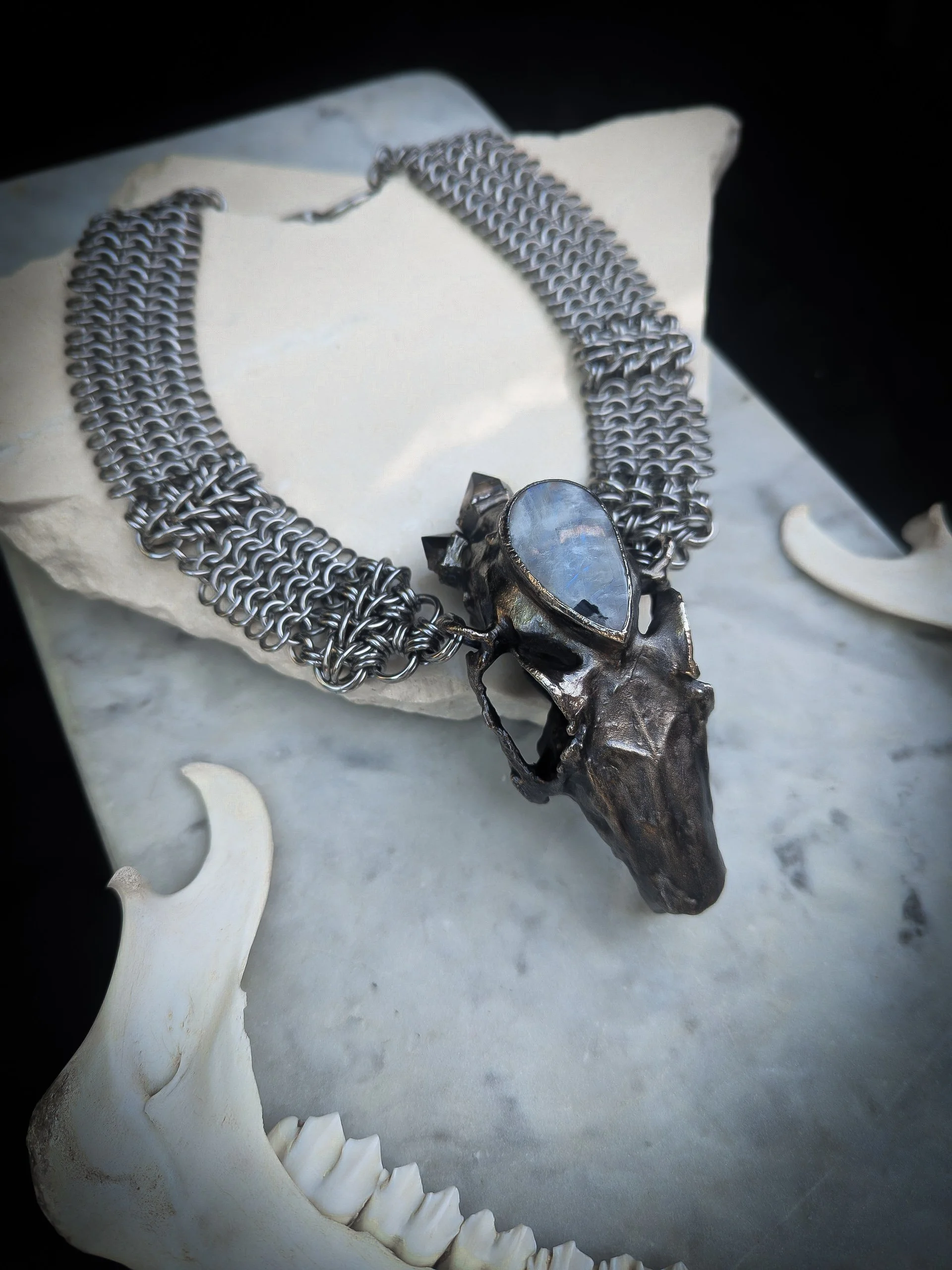
Artwork title: ‘Boudica’s Prophecy’ - exhibited in ‘Folklore’ at Tanglewood Gallery
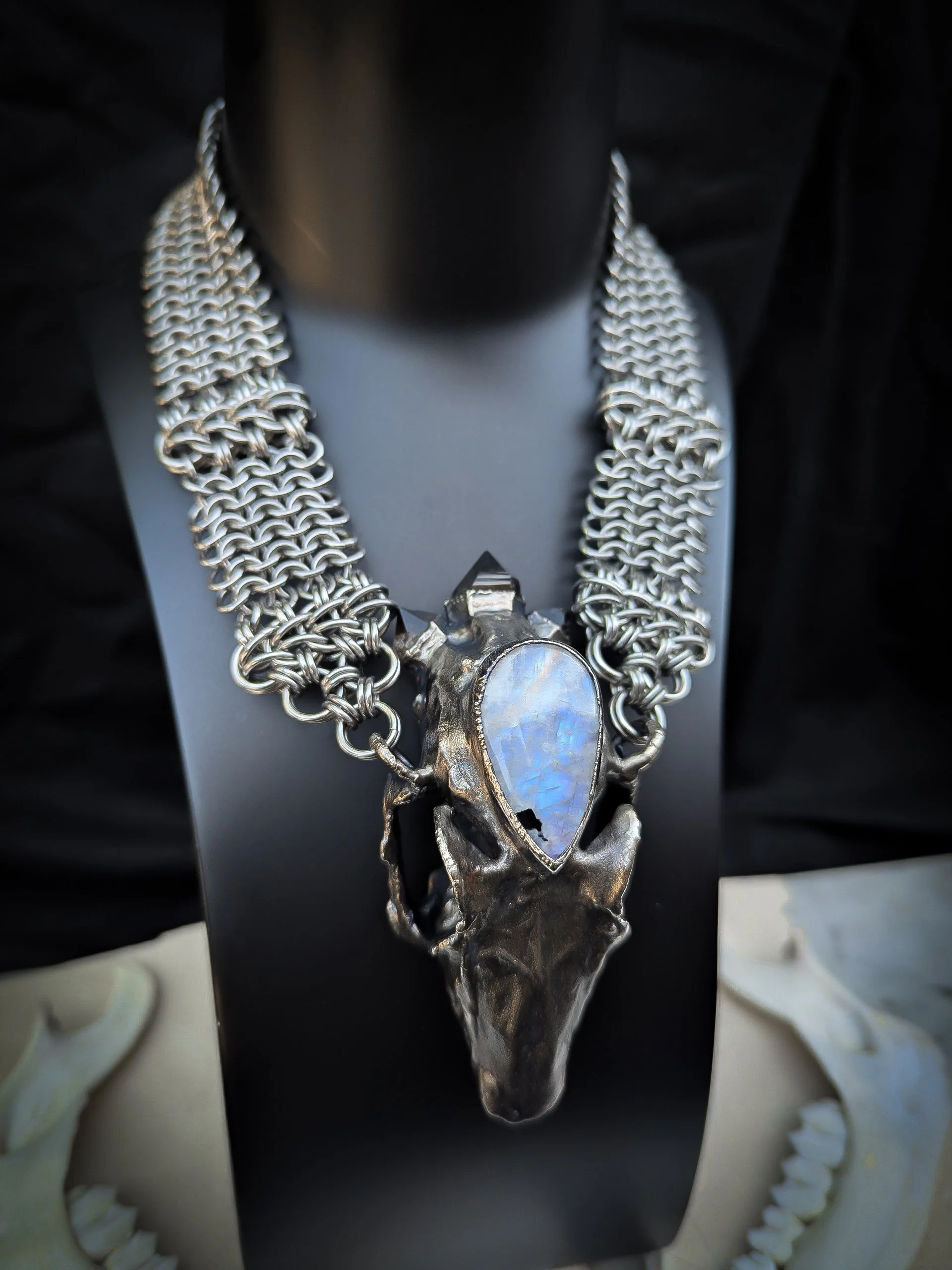
Medium: Electroformed Hare skull in copper and nickel with Rainbow Moonstone & Smoky Quartz embellishments and chainmaille collar
Artist’s Statement: This amulet was inspired by the tale of Boudica, the Pagan Warrior Queen of East Anglia, and her encounter with a sacred Hare on the eve of battle against the Romans as she fought to defend her homeland. Preserved in metal, the Hare bones evoke courage, animist wisdom, and ancestral connection. The chainmaille references battle armour and Boudica’s fight to protect the sacred. The work invites reflection on humanity’s enduring bond with the wild earth and the power of folklore to keep stories of resilience alive.
Throughout ancient Britain, Ireland, Scotland and Wales, the Hare is a creature that has long been associated with folklore and myth. One particular story that speaks of this sacred animal is the tale of Boudica, The Pagan Warrior Queen of East Anglia. The Roman historian Tacitus described her presence in striking terms: “She was very tall, the glance of her eye most fierce; her voice harsh. A great mass of the reddest hair fell down to her hips. Her appearance was terrifying”.Her story is part history, part folklore, part legend. It is told that Boudica bravely led a failed uprising against the conquering forces of the Roman Empire around 60 AD. Moments before the final battle, a Hare appeared to her, which Boudica interpreted as an omen foretelling the outcome of the battle ahead.
“Out from the scrub close by broke a hare, just as I have seen them break from the corn before a line of reapers. The hare that is sacred to all the Tribes…Close before the hillock it checked and sat up on its haunches; and I saw the beauty of it, the full, light-bloomed eye, the sunlight striking through its long quivering ears…For a breath of time it seemed to be looking at the Queen; then with a thrust of its powerful hind legs it sprang forward and went racing straight along our battle line.”
Excerpt from ‘Song for a Dark Queen’, by Rosemary Sutcliff
When I first read this story, I was moved by Boudica’s reverence for this creature, captured in the moment their eyes met across the battlefield. It struck me that this moment was rendered especially significant by its timing, as this encounter unfolded on the very threshold of the cultural erasure of her people’s beliefs. Roman occupation, which would eventually bring with it the spread of Christianity, would seek to extinguish the animist and pagan traditions so deeply interwoven within Brittonic culture in the years that were to come. Though the Britons ultimately lost this battle, the presence of the Hare in this prophetic moment, and Boudica’s faith in its meaning illuminated her profound connection to animism and to her homeland.
I created this amulet in honour of Boudica’s unwavering strength and resilience, and to venerate the fierce defiance of a woman who rose to defend her homeland against colonisation. Designed as a battle talisman, it evokes a protective garment fit for a warrior queen to wear into combat as both armour and spiritual safeguard in a final stand against an empire that threatened to destroy all that was sacred to her.
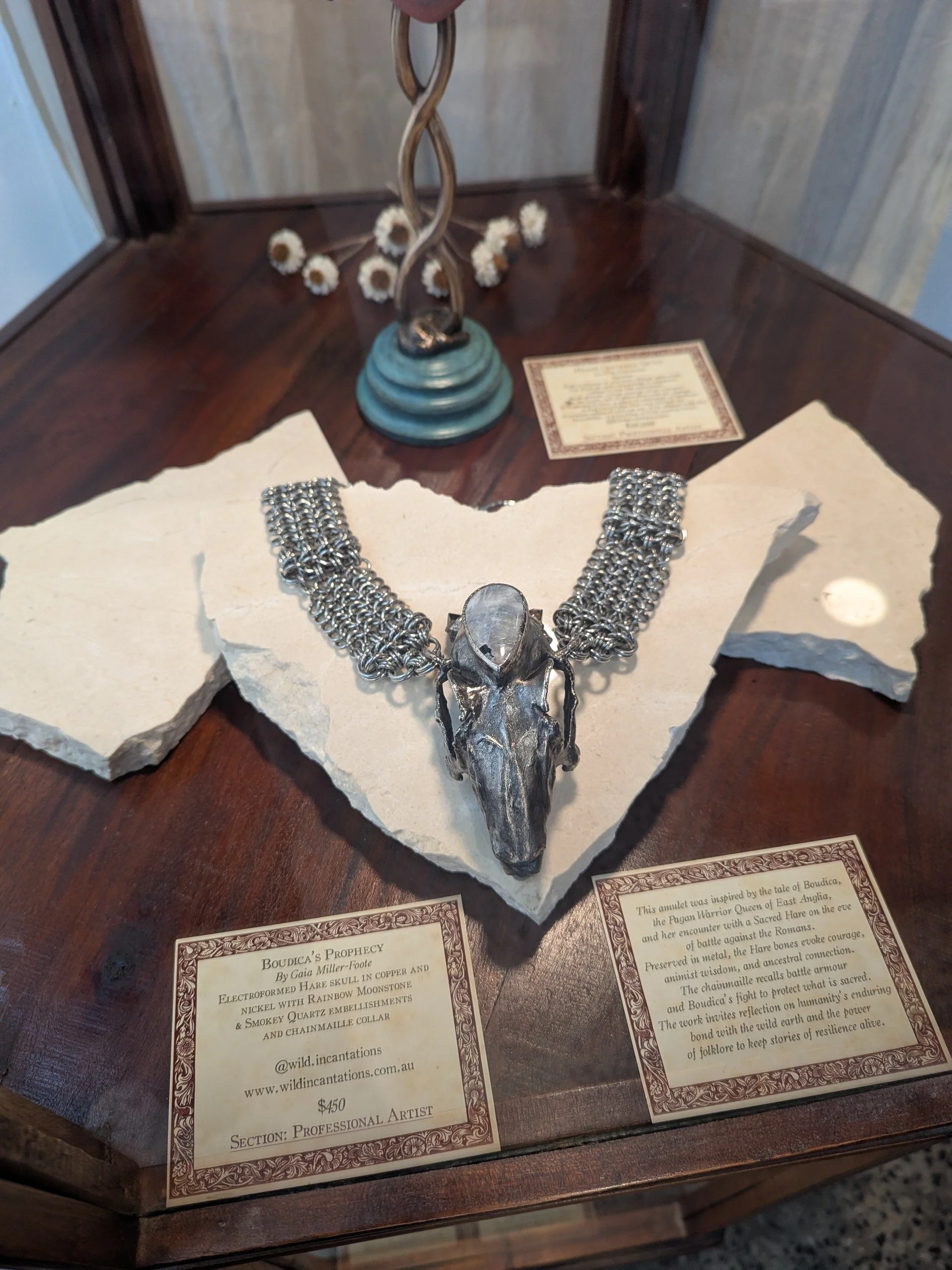
The incorporation of a chainmaille weave references the material language of battle dress, echoing the kinds of garments worn by Boudica and her warriors, and drawing on historical memory and interpretation rather than strict reconstruction.
The Hare skull in this amulet is a deliberate homage to the creature of Boudica’s prophecy, embodying her deep connection to her homeland and to the living earth itself. The Hare skull used in this amulet was scavenged several years ago while I was trekking through a rugged alpine region of Te Waipounamu, Aotearoa/New Zealand’s South Island. Non-native to this land, the bones of this Hare carry echoes of a creature once revered in folklore and legend in its homeland, now unceremoniously displaced and rendered expendable. Existing in this foreign landscape as a destructive, introduced species, the Hare stands as a quiet reminder of the enduring impacts of colonisation and the disruptions to land and life that persist long after its arrival. The bones remind us of the consequences of disregarding the sacred connection between ourselves and the natural world. Preserved and enshrined in metal through a process of electroforming, the immortalised remains of this Hare also symbolise the enduring spirit of Boudica’s legacy.
The Romans’ conquest of Britain during the time of Boudica, and the spread of Christianity that was to follow, severed the intimate bond between the Britons and their land, a cycle which was repeated centuries later as Britain expanded violently across other continents. In so many aspects of modern life we have become detached from those sacred relationships with land. The enduring harms perpetuated by colonisation and capitalism are a constant reminder of what happens when we experience a profound sense of fracture and loss of connection to the sacred earth. This is something that I strive to find reconnection with through my art.
Boudica is the embodiment of resilience and courage in the fight for what is sacred. In the present day, as our connection to the wild earth is increasingly under threat, it becomes ever more vital to defend this relationship. I seek to carry Boudica’s strength and resilience with me, and to safeguard the memory of what she stood for through art and storytelling. I am grateful for the folklore that keeps alive the spirit of the creatures, plants, and landscapes from my ancestral homeland, and for warrior queens like Boudica, whose enduring legacy invites us to reconnect with the magick of the earth and offers guidance for healing and a way forward.